The BLMP team recently presented papers on a dedicated panel at the IASPM UK & Ireland annual conference.
The conference was originally due to take place at the University of West London this summer, but was moved to an online format due to the ongoing COVID-19 situation. Papers were pre-recorded as video presentations, and the panel discussion took place via video conferencing.
IASPM have made a recording of the panel discussion available on their website, along with the individual, pre-recorded papers and abstracts. You can visit that page here. We’re also making those videos available on this page.
This paper begins by outlining the concept of the live music ‘ecology’ as applied to specific localities (notably cities) and the various relationships within them – such as between venues, musicians, promoters, councils and licensing officers. It considers the research background to the current project – the ‘live music census’ methodology, as deployed in individual cities from Melbourne, to Edinburgh and, latterly, across the UK – and then moves on to examine its wider applications. Through a discussion of the relationship between local music, national polities and their international contexts, it highlights the interconnectedness of live music ecologies, and economies.
The potential ramifications for local music ecologies in the UK from Brexit, for instance, are considerable. Even beyond the problems faced by touring acts, the ‘cultural pushback’ of perceptions that Britain is harder to visit could limit opportunities for local promoters and venues. Disruptions to supply chains risk additional challenges for festivals and production companies, and limits to free movement could impact local economies – like the Midlands – heavily dependent on recruitment of skilled workers from Europe, and on a tourist economy. This paper examines sets up the theoretical context, and practical consequences, for the interdependence of local music and national policy.
Craig Hamilton, “Gathering the Data – Means, Methods and Mapping”
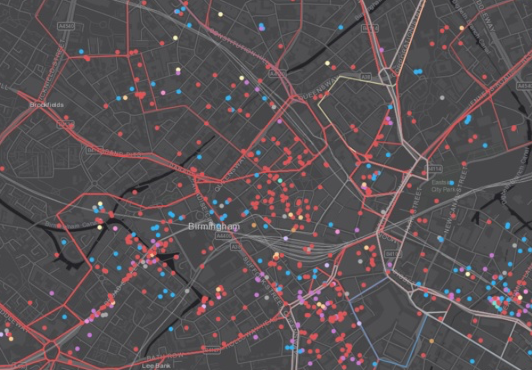
The second paper in the panel focuses on the methodological aspects of the current project. It outlines the technical processes of scraping data from such sources as local and national listings to provide baseline data of the size and scope of Birmingham’s live music ecology – the number and type of venues, the spread of musical activity across the different areas of the city. Through an explanation of the preliminary mapping of the city’s music spaces, the ‘snapshot’ census of live music activity, the surveys used to assess longer term activity and the triangulation of these sources to assess the overall picture, this paper places the project within the wider context of sectoral research. It discusses the specificities of data gathering in one city, and how the local conditions impact and inform the technical and human dimensions of accounting for a live music ecology. Illustrating the divergences and similarities between researching the sector in Birmingham and in other cities, it moves from an account of the methodology to outlining the data analysis and preliminary findings, demonstrating both the replicability of the method, and the iterative nature of the research process.
Patrycja Rozbicka, “Birmingham’s Perspective – Local Responses and Concerns”
This paper concentrates on the participants within the Birmingham live music ecology, the qualitative aspects of the research and the consultation process that feeds into it. With a core network of local actors including Birmingham City Council, the Birmingham Music Coalition, and the Birmingham Music Archive – as well as national agencies – the project seeks to incorporate stakeholder perspectives throughout the research as part of a process of the co-production of knowledge. Building on the previous papers’ accounts of the national and international policy contexts, and the data gathering, this section of the panel moves onto a synthesis of the specific implications for local businesses and policymakers of the research findings. It provides a picture of the key concerns for Birmingham’s live music ecology, drawing on the wider dataset and first-hand accounts of both the historical and present-day cultural activity in the city, and their intersection with local government and civil society. With a view of the wider structural picture provided by the overarching research findings, this paper looks to strategies for communication and co-ordination in response to the challenges thrown up by Brexit for Birmingham and the West Midlands – the localized approach to national policy shifts.